





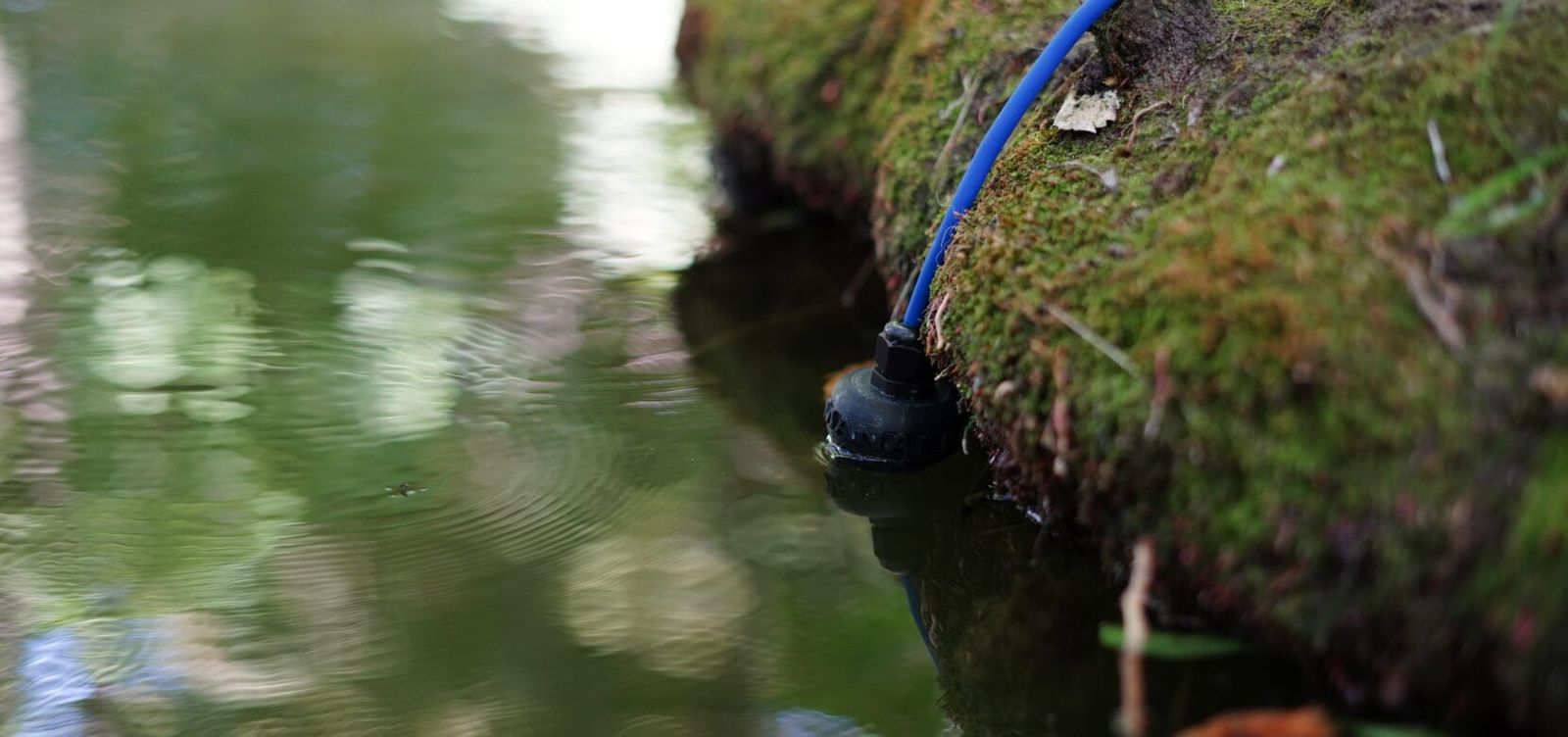
A hydrophone is a microphone made for listening underwater. It picks up the vibrations travelling through water and turns them into sound you can listen to on headphones or record. Whales, dolphins, rivers, bubbles, a boat passing in the distance: a whole world you never hear from the surface!
I make my microphones by hand, and the question I get most often is: “how do I choose the right one?” So here's everything you need to know, no fuss, with sounds to give you an idea.

Listen first
Before the explanations, the best thing is to listen. Put on some headphones, it's far more impressive!
How does a hydrophone work?
Underwater, sound travels about 4 times faster than in air: nearly 1,500 metres per second, against 340. And it carries much further. The problem is that a regular microphone isn't made for this. Even slipped into a waterproof bag, it hears almost nothing: the sound bounces off the boundary between water and air.
A hydrophone solves this problem. Inside, there's a piezoelectric capsule, a small element that produces an electrical signal when the water's vibrations compress it. On our hydrophones, this capsule is protected by a waterproof acoustic gel: the mic stays waterproof while keeping as much frequency range and sensitivity as possible.
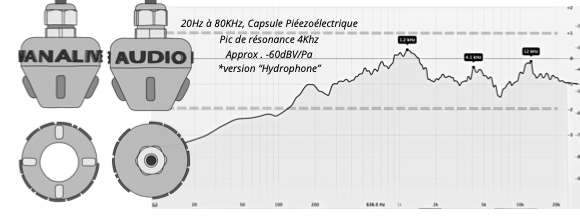
The result: from 20 Hz to 80 kHz, with a resonance peak around 4 kHz. And since the capsule is passive, there's no need for 48 V phantom power!
What can you hear underwater?
Far more than you'd imagine! Pebbles rolling along a river bed, rain pattering on the surface, a boat engine in the distance, fish nibbling at bait, dolphins, whales… One of our customers even tested it with “a small valve guitar amp, a big glass of water and a straw”. His verdict: “it works great”!
Sound designers, nature recordists, artists: what they do with it
Our hydrophones go to very different people, and each uses it in their own way.
For sound designers
It's a real texture generator! Bubbles, swirls, rumbles, metal ringing underwater: sounds no regular microphone picks up, and that you won't find in ready-made sound libraries. Dip an object into a basin, rub it, make it vibrate, and sample the result to build your own sound library.
With the accessories, the playground gets bigger: the magnet on a metal sheet, the suction cup on a window, the spike in the ground. And since the mic goes up to 80 kHz, you can slow your recordings down without them turning dull (more on that below).
Our microphones for sound designers
For nature recordists
Underwater, wildlife can't be seen, but it can be heard. Gaby Muñoz, a Colombian filmmaker based in Barcelona, took our hydrophone out to sea with pilot whales. Corto SPM listened to a pod of dolphins, and Allan Linares recorded the bubbles of a salt marsh releasing gas at low tide.

You don't have to go to sea, though: a pond or a river is enough. Fish, currents, rolling pebbles… Frantz Loriot even carried out a whole recording project along the Sihl, a Swiss river.
Our microphones for nature recordists
For artists
The hydrophone also opens the door to performance and sound installation. In Milan, a four-hour performance in the Mincio swimming pool brought together sound compositions, Bluetooth speakers sealed inside balloons held on leashes… and a hydrophone.
A swimming pool, an aquarium or a simple basin can become a stage!
Our hydrophones and geophones for artists
See and hear the community's creations
How to choose your hydrophone
You don't need a scientific model costing several thousand euros for field recording or sound design. What really matters comes down to these five points.
1. The plug: it depends on your device
It's the first thing to check, and it's often where people get it wrong! The hydrophone plugs into a mic input, so the plug has to match your device:
- 3.5 mm mini-jack : for small recorders and phone interfaces.
- 6.35 mm large jack : for an amp, a mixing desk or a sound card with a jack input.
- XLR : for field recorders such as the Zoom H4n, H5 or H6, and pro gear.


Not sure? Check your recorder's mic input before ordering, or just ask us. Write to us
2. Cable length: 3 m or 8 m?
3 metres is perfect for a river, a stream, a pond, a pool or a basin: you're at the edge, and the hydrophone is right in front of you.
As soon as you're higher up, take 8 metres. From a pontoon, a quay or a boat deck, the cable first has to reach the water before it can sink. And 3 metres goes very quickly!

3. Passive or powered?
Some hydrophones need a power supply. Ours are passive: you plug in, and that's it. You do, however, always need a device that amplifies the signal, as with any microphone. Plugged straight into a phone or a computer, it won't work!
See which devices work with our hydrophone
4. Frequency range… and your recorder
Our hydrophone goes up to 80 kHz, well beyond human hearing, which stops around 20 kHz. To keep those ultrasounds, your recorder has to keep up: at 48 kHz it records up to 24 kHz; at 96 or 192 kHz it captures much higher. Handy for dolphin clicks, or for slowing a sound down in sound design without it turning dull!
5. Accessories
A hydrophone that only does one thing is a shame. Ours comes with its weight so it sinks, and takes other heads that swap in a few seconds:
- Float : to stay at the surface, or to fill with sand and turn into a maraca!
- Magnet : to listen to a hull, a tank or a metal structure.
- Suction cup : for windows and flat surfaces.
- Ground Spike : to listen to the ground.
- Bait : slip some bait inside, and listen to the fish come and nibble all around.

Which version for which use?
| You want to… | Cable | Plug | Price |
|---|---|---|---|
| Listen to a river, a pond, a pool | 3 m | Depends on your device | 79,99 € |
| Record from a boat, a pontoon or a quay | 8 m | Depends on your device | 89,99 € |
| Try everything: water, metal, windows, ground | 8 m + all 5 accessories | XLR | 109,99 € |
Every hydrophone is handmade in France and tested before shipping. See the hydrophone versions and prices
The mistakes we all make at the start
- Gain too low. A hydrophone's signal is weak: turn the gain up properly, then adjust.
- 48 V switched on. Pointless on a passive hydrophone, switch it off.
- A rubbing cable. Against a hull, a rock or a pontoon, the slightest rubbing is very loud. Let the cable hang freely and move as little as possible.
- The plug in the water. The mic is waterproof, the plug isn't! Keep it dry.
- Forgetting to rinse. After the sea, a quick rinse in fresh water and you're done.
All our tips for looking after your hydrophone
Your questions
Can you plug a hydrophone into a smartphone?
Not directly. You need a phone interface, such as the Smart Rig II, with a recording app. To simply listen at sea without recording, a small amp like the HoneyTone Amp does the job nicely.
How deep can it go?
The mic is 100% submersible. In practice, the cable length decides: 3 or 8 metres.
Does it work in salt water?
Yes, in fresh water as well as salt water, hot or cold. Just remember to rinse it in fresh water after every trip to the sea.
Can you hear fish?
Yes! Slip some bait into the Bait accessory: fish come and nibble all around, and you hear them up close.
Ready to listen underwater?
Our hydrophone is handmade in France, tested before shipping and rated 4.9/5 by our customers. It's available from €79.99!