





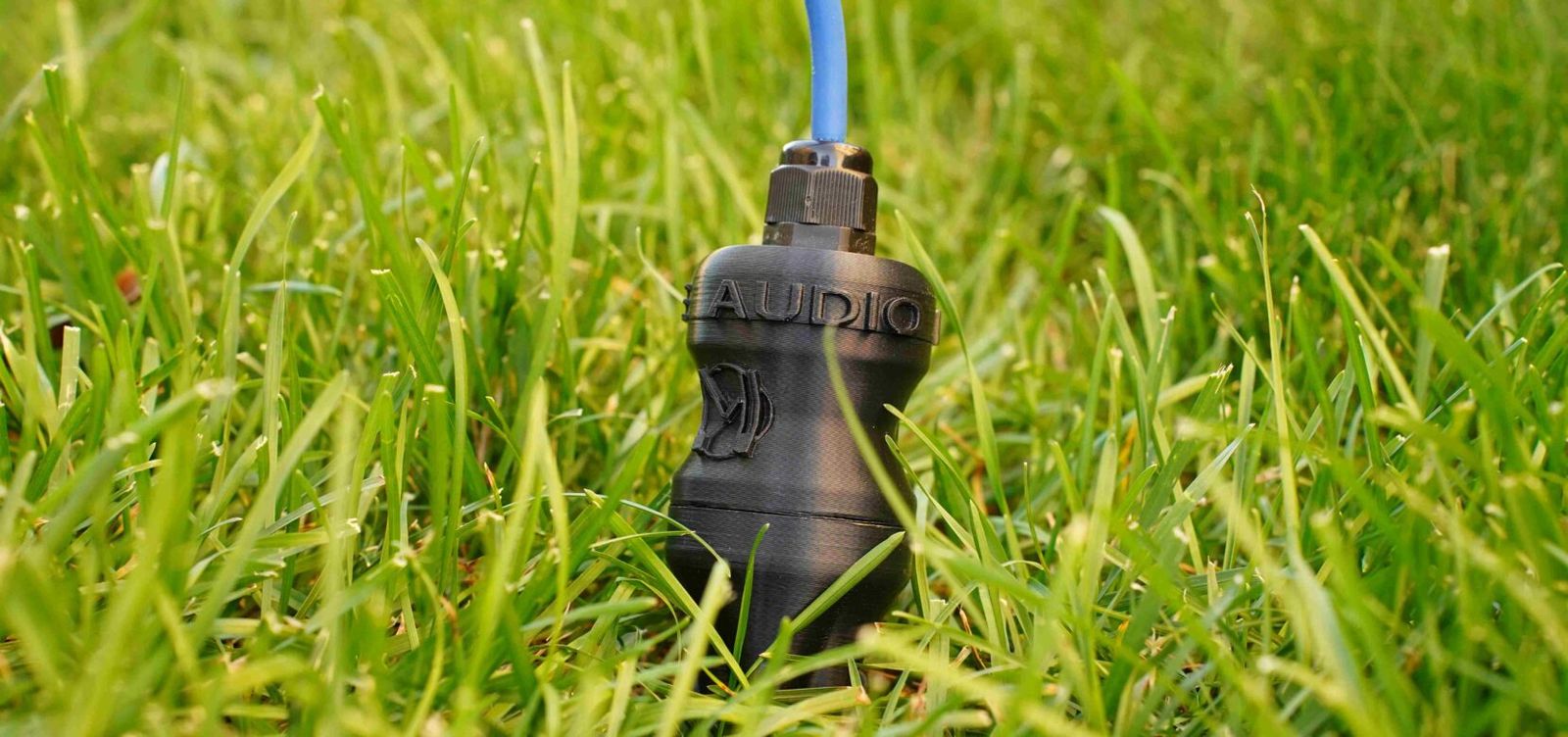
A geophone is a microphone that doesn't listen to the air, but to matter. It picks up the vibrations travelling through the ground, wood, metal or ice, and turns them into sound. A heartbeat, footsteps in a forest, a running machine, a creaking tree: sounds that a regular microphone can barely hear!
I make my geophones by hand, and people often ask me what they are really for and how to choose the right one. Here are the essentials, kept simple, with a sound to give you an idea.

Listen first
Put on headphones with good bass: on a phone speaker, you'll miss the best part.
How does a geophone work?
The geophone started out as a geologist's tool. It is planted in the ground to measure the earth's vibrations during seismic surveys. In a typical geophone, a magnet and a coil move relative to each other when the ground vibrates. This movement creates a small electric current: that is the signal you record.
A regular microphone picks up changes in air pressure. The geophone listens to what it touches. That's why it hears lows, impacts and friction so well, and picks up very little of the noise around it.
Our geophone is built around an omnidirectional seismic sensor. It covers 5 Hz to 5,000 Hz, with a flat response from 15 Hz. For comparison, the human ear starts hearing at around 20 Hz: the geophone goes even lower! And it needs no 48 V phantom power.
What can you hear with a geophone?
- The body : held against the chest, it lets you hear your heart beating.
- The ground : footsteps, a distant rumble, anything that makes the earth vibrate around you.
- Wood : a tree bending in the wind, a creaking floor, a table being tapped.
- Metal : a handrail, a metal sheet, a radiator, a wire fence set vibrating.
- Machines : a washing machine on full spin, a fridge, an idling engine.
- Instruments : the body of a guitar, a drumhead, a kalimba.
Who is the geophone for?
Our geophones go to very different people. Here's what each of them is looking for.
For sound designers
The geophone is a goldmine of impacts, lows and drones. A slamming door recorded through the wall, a machine heard through the Suction cup, a heartbeat for a suspense scene: sounds of your own that you won't find in sound libraries.
Another plus: since it mainly listens to what it touches, the geophone leaves out much of the background noise. Handy when you don't have a studio!
Our microphones for sound designers
For nature recordists
The geophone takes field recording where the ear can't go: beneath your feet. Planted in the ground, wedged against a tree trunk or laid on the ice of a frozen lake, it lets you hear nature from the inside.

Our microphones for nature recordists
For musicians
Placed against a guitar or a drum, the geophone picks up the vibrations of the wood and the skin rather than the sound in the air. The result is very different from a regular recording: use it on its own or blend it in. And a heartbeat makes a surprising rhythm track!
For artists
For a sound installation or a performance, the geophone turns any structure into a sound source. Under a stage floor, the dancers' steps become the music. On a wooden table, visitors play without even knowing it.
Our hydrophones and geophones for artists
How to choose the right geophone?
You don't need a lab-grade sensor for sound design or field recording. Here's what really matters.
1. Geophone or hydrophone?
That's the first question to ask. If you want to listen underwater, you need a hydrophone. If you want to listen to the ground, wood, metal or the body, it's the geophone.
Good news: our two microphones use the same heads. If you already have one, your accessories screw onto the other.
Hydrophone: what is it and how to choose one?
2. Geophone or contact microphone?
A piezo contact mic also listens to vibrations, and often costs less. But it's mostly at home in the mids and highs. The geophone is made for the lows: it's what gives weight to an impact or a rumble. If bass is what you're after, choose a geophone.
3. The plug: it depends on your device
The geophone plugs into a microphone input. So the plug must match your device:
- XLR : for most recorders and sound cards. It's the sturdiest, and the one I recommend.
- 6.35 mm large jack : for a guitar amp, a DI box or a recorder with a jack input.
- 3.5 mm mini-jack : for small recorders with a mini-jack input, such as the Zoom H1 or some Tascam models. Not for a smartphone or a speaker.


Not sure? Check your device's microphone input before ordering, or ask us. Write to us
4. Passive or powered?
Our geophone is passive: no battery, no 48 V power. However, like any microphone, it needs a device to amplify its signal. Plugged directly into a phone, a computer or a speaker, it won't work!
5. Frequency range, especially at the low end
For a geophone, what matters is the lows. Ours goes down to 5 Hz. Just make sure your recorder doesn't cut those lows: many have a low-cut filter that you need to switch off.
6. The cable
Our geophone has 3 metres of cable. That's ideal for sounds within arm's reach, and enough to avoid walking next to the mic during the take. Need to go further? On the XLR and large jack versions, you can add an extension cable.
7. Accessories
The geophone comes with its Ground spike. Other heads screw on in a few seconds:
- Ground Spike (included with the geophone): for listening to the ground.
- Magnet : for metal surfaces.
- Suction cup : for windows and flat surfaces.
- Float : fill it with sand or small pebbles to turn it into a maraca!

8. Waterproofing
In its standard version, our geophone is not waterproof: keep it dry, especially in wet grass or on ice. A waterproof version is coming soon. In the meantime, for anything happening in water, go for the hydrophone.
Which version for which use?
| You're plugging into… | Plug | Accessories | Price |
|---|---|---|---|
| A field recorder or a sound card | XLR | Ground Spike | 129,99 € |
| A guitar amp or a DI box | 6.35 mm large jack | Ground Spike | 129,99 € |
| A small recorder with a mini-jack input | 3.5 mm mini-jack | Ground Spike | 129,99 € |
| You want to try everything: ground, metal, windows, maracas | XLR | Ground spike, Magnet, Suction cup and Float | 139,99 € |
Every geophone is handmade in France and tested before shipping. See the geophone versions and prices
Torn between models? We've compared the geophones on the market, with prices and specs. Geophone comparison: Manalive Audio, LOM Geofón and Leaf Audio
The mistakes we all make at the start
- Listening on small speakers. The geophone's lows get lost. Use headphones.
- Leaving the low-cut filter on. It removes exactly what the geophone picks up best.
- Gain too low. The signal is weak: turn the gain up boldly, then adjust.
- Moving during the take. The geophone hears your footsteps and the slightest rub of the cable. Stay still.
- Poor contact. Placed at an angle or poorly planted, it picks up much less. The firmer the contact, the better the sound.
All our tips for using your geophone well
Your questions
What's the difference between a geophone and a regular microphone?
A regular microphone listens to the air. The geophone listens to the matter it touches: the ground, wood, metal, the body. It picks up lows and vibrations that a regular microphone can barely hear.
Can you plug a geophone into a smartphone?
Not directly. You need an interface with a microphone input to amplify the signal. The simplest option is still a recorder.
Can the geophone be used underwater?
Not the standard version, which isn't waterproof. For water, you need a hydrophone. A waterproof version of our geophone is coming soon.
Do my hydrophone accessories fit the geophone?
Yes! Both of our microphones use the same heads. They screw on in a few seconds.
Ready to listen to matter?
Our geophone is handmade in France and tested before shipping. It's available from €129.99, with its Ground spike!
Read next
- Using your geophone: connection, settings and accessories
- Geophone comparison: Manalive Audio, LOM Geofón and Leaf Audio
- Hydrophone: what is it, how does it work and which one should you choose?
Sources
The specifications of our microphones come from our own measurements and product sheets. For everything else, here are the references this article is based on.