





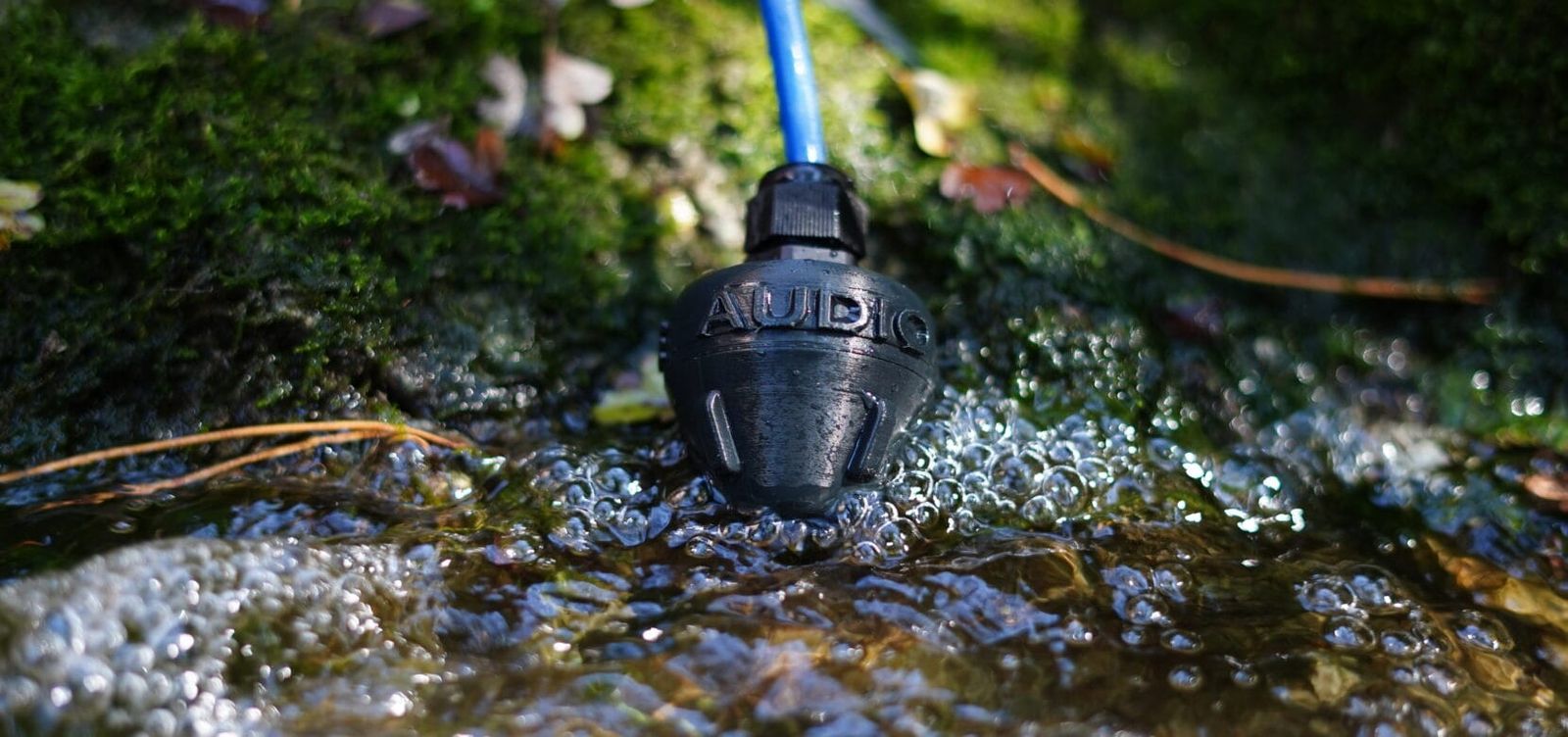
Looking for sounds nobody has in their sound library yet? The simplest way is to record them yourself, with a microphone that hears what a regular mic can't pick up. For sound design, our two microphones complement each other: the hydrophone listens in water, the geophone listens to vibrations in matter. Here are lots of ideas to try, but keep in mind that everyone uses them their own way: your imagination sets the limits!
Hydrophone and geophone: two microphones for sound design
The hydrophone listens in water. Its piezoelectric capsule, protected by a waterproof acoustic gel, covers 20 Hz to 80 kHz: bubbles, swirls, drops, clinks.
The geophone, for its part, listens to matter. Built around a seismic sensor, it picks up vibrations from 5 Hz to 5,000 Hz. Placed on a table, on a metal sheet or planted in the ground, it hears bass and impacts in a very different way from a microphone in the air.
Both plug in without 48 V phantom power, into any recorder with a mic input, and share most of the accessories.
Sound ideas for the hydrophone
- An effervescent tablet in a glass of water: the fizzing aspirin becomes a shower of tiny crackles. Great for magic, electricity or fire!
- Ice cubes cracking as they melt in a bowl of water.
- Bubbles blown through a straw, slowly or very fast. Slowed down, they make surprising creature sounds.
- A basin and some objects : keys, marbles, a small chain you drop, rub or shake underwater.
- A metal object struck and then dipped into water: a gong, a plate, a lid. The note bends as it enters the water!
- Rain on a pond, or a trickle of water running into a bucket.

My tip: record at 96 kHz if your recorder allows it. The hydrophone goes well beyond what we can hear, and your slowed-down sounds will stay richer.
Sound ideas for the geophone
- Your heart : placed against your chest, the geophone lets you hear the beats. For suspense, horror or a point-of-view shot.
- Footsteps on a wooden floor, gravel or packed earth, with the Ground Spike planted right next to them.
- Impacts : a slamming door, a fist on a table, a heavy object falling.
- Metal with the Magnet: a radiator you tap, a railing, a metal sheet, a wire fence you make vibrate.
- A machine : a washing machine on full spin, a fridge, an idling engine. With the Suction cup, it's a real drone generator.
- Homemade maracas : fill the Float with sand or small pebbles, shake it, and record it all from the inside!

Another advantage: the geophone picks up very little airborne noise. It mostly listens to what it touches.
Please note: in its standard version, the geophone is not waterproof. Keep it dry, and use the hydrophone for anything that happens in water. A waterproof version of the geophone is coming soon!

Accessories: everyone finds their own uses
The heads screw on in a few seconds. Here's what they're most often used for, but nothing stops you from inventing your own uses:
- Ground Spike : to listen to the ground. Supplied with the geophone, it also screws onto the hydrophone.
- Magnet : for metal surfaces, on both microphones.
- Suction cup : for windows, machines and flat surfaces, on both microphones.
- Float : to keep the hydrophone at the surface, or to make a maraca once filled with sand.
- Bait : on the hydrophone, to hear fish come and nibble.

Your questions about sound design
Which microphone should I choose for sound design?
It all depends on the sounds you're after. For water (bubbles, drops, swirls), it's the hydrophone. For vibrations, impacts, bass and objects, it's the geophone. Many sound designers end up with both!
Do I need a special recorder?
No, a recorder or sound card with a mic input is enough, for example a Zoom H4n, H5 or H6. No 48 V phantom power needed.
Can the geophone go in water?
Not the standard version, which isn't waterproof. For water, take the hydrophone. A waterproof version of the geophone is coming soon.
And everyone else?
The same microphones are also used for plenty of other things:
- Our microphones for nature recordists : dolphins, nibbling fish, marshes, cracking ice and trees.
- Our hydrophones and geophones for artists : sound installations and performances.
- Our microphones for musicians : samples, water and instruments heard differently.
Ready to record?
All that's left is to find your sounds! The hydrophone is available from €79.99, the geophone from €129.99. Both are handmade in France and tested before shipping.